
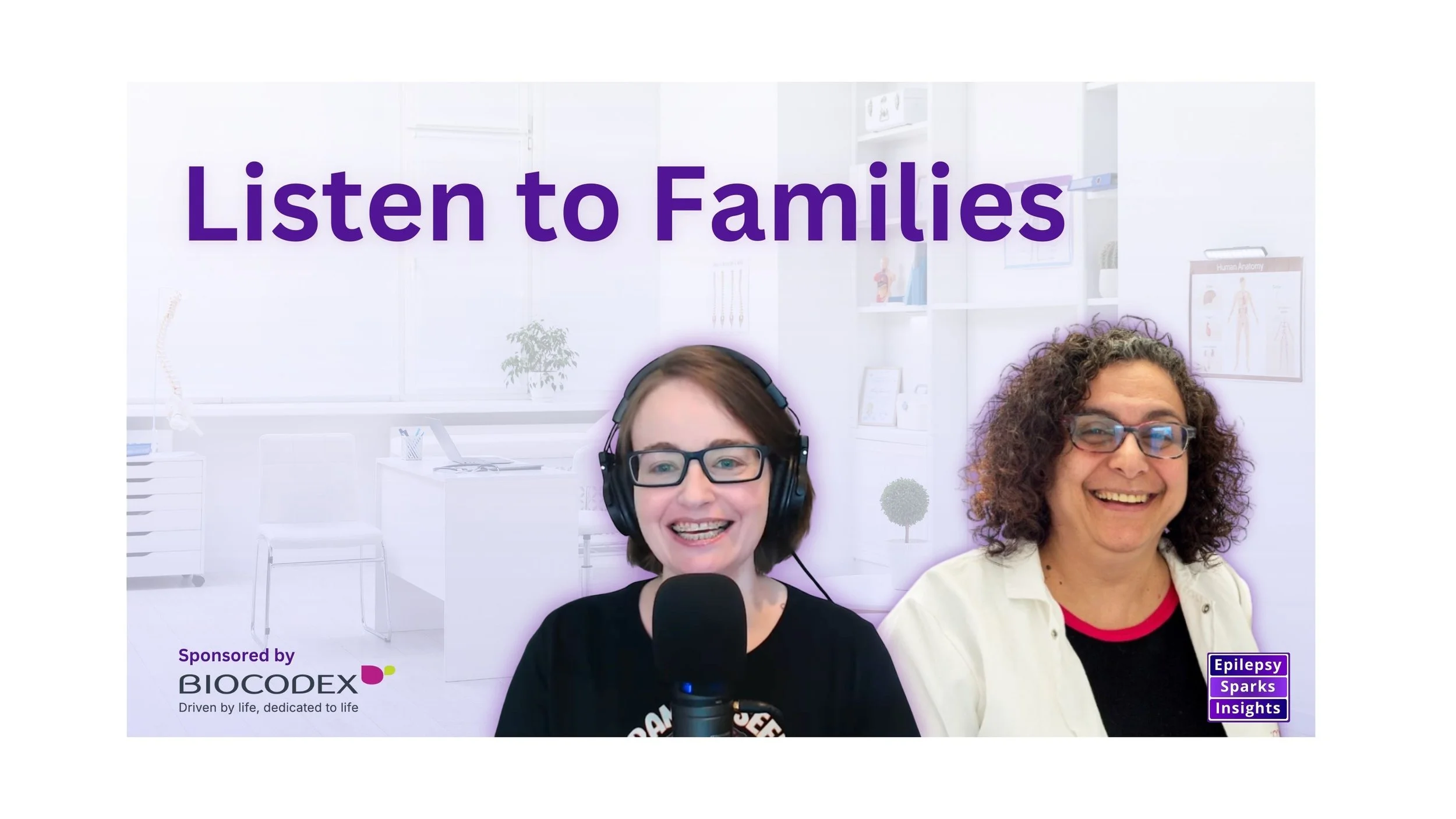
Why Clinicians Must Listen to Families Living With Dravet Syndrome - Prof. Rima Nabbout, Necker-Enfants Malades, Université Paris Cité and Institut Imagine, France
This conversation explores the rare epilepsy: Dravet Syndrome, beyond seizures, focusing on how listening to families can transform care, decision-making, and quality of life across the lifespan. Prof. Rima Nabbout shares findings from the Biocodex-supported D’Unseen project, highlighting how ethnographic research reveals unmet needs, shifting priorities over time, and the critical role of family advocacy in rare and complex epilepsies.
📺 Watch the Interview
🎧 Listen to the Podcast
👉 Listen on Spotify | Apple Podcasts | YouTube
Sponsorship disclosure:
This episode was sponsored by Biocodex. The sponsor proposed the topic, selected the guests, and reviewed the planned questions in advance. The discussion, recording, and final editorial decisions were made independently by Epilepsy Sparks. The sponsor reviewed the edited episode prior to release and did not request changes.

Episode Highlights
Dravet Dyndrome as a disease affecting development, behaviour, and daily life - not seizures alone
Why families are central to understanding needs across childhood, adolescence, and adulthood
How different coping styles shape communication, trust, and care decisions
Key insights from the D’Unseen ethnographic study on empowerment and anticipation
The role of advocacy groups in supporting families and clinical care
Why shared uncertainty and honesty strengthen clinician-family relationships
About Prof. Rima Nabbout
Rima Nabbout is a paediatric neurologist specialising in rare and complex epilepsies. She leads the reference centre for rare epilepsies in Paris and is a founding member of the EpiCARE European Reference Network.
Full profile: Rima Nabbout
Organisations/publications mentioned
Topics and terms mentioned
dravet syndrome
developmental delay
behavioural challenges
hypervigilance
ethnographic research
caregiver roles
patient organisations
Paper reference:
The seen and unseen facets of Dravet syndrome across the disease trajectory: Insights from European ethnographic research, https://www.epilepsybehavior.com/article/S1525-5050(25)00549-9/fulltext, Dorris L, Aras LM, Danse M, et al., Epilepsy & Behavior, Jan 2026, DOI: 10.1016/j.yebeh.2025.110809
-
00:00 Rima Nabbout
“Do not forget about what the families can do for the families. Do not forget about the advocacy groups in your countries, in your environment. If they are existing, give them a role in this. Give them a place in this. Support them and empower them to have a bigger place in this.”
00:30 Torie Robinson
Welcome to Epilepsy Sparks Insights! I’m your host, Torie Robinson, and here we talk with specialist clinicians and researchers to spark improved understandings of the epilepsies worldwide. If you’re new here, please subscribe so you don’t miss future conversations - and today: a huge thanks to Biocodex for sponsoring this episode
Today, I’m joined by paediatric neurologist Prof. Rima Nabbout of Necker-Enfants Malades, Institut Imagine, and EpiCARE. She shares with us her expertise on the rare epilepsy - Dravet Syndrome - and the Biocodex project “D’Unseen”. She’ll speak of the complexities beyond seizures, and why listening to families is essential for understanding and improving quality of life across the lifespan.
01:09 Rima Nabbout
Hello everyone. I'm Rima Nabbout. I'm a professor of paediatric neurology, working mostly in childhood epilepsy. And I'm directing the reference centre for rare epilepsy at Necker-Enfants Malades, Université Paris Cité and Institut Imagine in Paris, France. And I'm a founder and part of the network, EpiCARE, which is the European reference network for rare epilepsies.
01:39 Torie Robinson
So, we are gonna be talking specifically about, um, something about Dravet Syndrome. What is Dravet Syndrome? What gene is affected? How does it all work?
01:46 Rima Nabbout
Dravet Syndrome, indeed, is a very good example of these rare and complex epilepsies. It is what we call by the definition a developmental and epileptic encephalopathy, because it is mainly impacting the individual who has this syndrome by having complex seizures, different types of seizures that are difficult to treat. But I would say even more important than the seizure, we have this impact on the development, on the cognition, on the developmental skills and other issues on the motor function, on the eating behaviour, on the sleep behaviour; making of the disease a complex disease, beyond the seizures.
And you asked me about the gene that is behind the syndrome; it is SCN1A, which is the Subunit 1 Alpha of a sodium voltage-gated channel, that is present in almost over 90% of cases. And indeed, it's because of this aetiology that we have, also, an impact behind the seizures because the gene, per se, will give rise to the seizures, but will give also, an impact on the development.
03:16 Torie Robinson
Exactly. And I think, like, the behavioural issues and the psychiatric issues, often, you know, there's additional things and then all of, all of this as a package often impacts the family, the caregivers as well.
03:27 Rima Nabbout
Many of our knowledge on this, indeed, comes from the families. Because when we discuss with the families, it's one of these diseases where we talk about seizures, definitely, but we discuss about all of these other issues that interestingly, also, change during lifespan. Because in a, I would say a small infant, that is the main problem in Dravet are the long-lasting seizures. And then the developmental, I would say, the collage will-will appear later on. The behaviour issue will become very important in older children and adolescents. The opposition will arrive there and some psychiatric features as autism or other psychiatric, uh, features. So, what is really important in this disease is to be very close to the family needs (because they are translating in many instances the patient needs), and to follow up these needs during the life span, because they might change, and they might be more or less important at different moments of the child’s life.
04:50 Torie Robinson
Exactly. Because these children can also become adults, right, as well. And then the question is how does it affect the adults differently from the adolescents and the small children? It can be very different, as you say.
05:00 Rima Nabbout
This point, Torie, is very important, about what these children become in adult life and as adults. And what is interesting is that in many instances, seizures may not remain the main problem. Definitely seizures may remain here, but all of these behavioural issues, all of the disorders of the neurodevelopmental impact, the cognitive issues, the autonomy of the patient, and the need is still for medication, for psychiatric care, for other type of care; are really very important to be taken in account.
05:44 Torie Robinson
I think all of that is so important when we are just looking at what we really want to achieve, which is the quality of life of the person right? It's looking at how do they feel, and then how do their caregivers and families feel as well. So, it's what, what is their life like? And I guess that's why we come to the study that you've been involved in/leading, um, called D’Unseen. Tell us about the project.
06:06 Rima Nabbout
This project is really very exciting and you can see when I talk about it¬
06:10 Torie Robinson
Yeah.
06:11 Rima Nabbout
Because it was a different approach, focussing on the needs of the families and introducing this anthropology approach - that is a very nice approach when it comes to quality of life to social and societal, I would say approaches. It went through an idea of saying why we do not, in a way, sit together and think about the impact of this disease together. The different stakeholders that are involved in the care, in the coordination of care, and in accompanying the patients through their life span and through years of this disease. And this is how it goes. And I would tell you more, but I would like, if you can, tell me if you have knowledge of such a project that are going into really very clearly this aspect of the disease.
07:20 Torie Robinson
Well, I don't think I'm a great person to ask, given my memory issues, haha, temporal lobe, epilepsy, resection. But I, but I can say, in my humble opinion, I don't think, to date, enough focus has been on (in research) quality of life of-of patients and of their families. Because we only see clinicians for a certain amount of time of our lives. And key decisions are made by clinicians, on what's gonna happen and what's gonna impact us all the time. And so, I think from my understanding of this study is that what it gives you is a, it gives you a wider view of the experience of the patient and the family. And it enables improved insight to make better decisions, um, decisions with the family and-and the patient.
08:07 Rima Nabbout
It is exactly what we try to do, and I hope that you'll be able to see the paper that is coming soon in Epilepsy and Behavior. So, the idea was to have these interviews, open interviews with the families that have children having Dravet Syndrome. What was very interesting that these were different families living in different social and cultural, I would say backgrounds, having in different countries, and interviewing at the same time, a nurse that is specialised in epilepsy and that she's in a tertiary centre of epilepsy, two doctors working and having a good experience in this disease, and in rare and complex epilepsies. And was a parent of a child with Dravet Syndrome and he was active within the Spanish organisation of Dravet. So, all of those people with a really important review of the literature, what is known about the syndrome, and there are some nice papers about the family's point of view. We had these interviews and we tried to understand: what is the situation of the families in different steps of this disease. So, we established, basically, I would say two important figures in this paper. One was to understand how families are coping with the disease and what would be, in a way, their position and their way of coping with the disease, and with this very important and complex situation. And we noticed that they were some families, what we call the “Gatekeepers”, for instance.
10:10 Torie Robinson
Mm-hmm.
10:10 Rima Nabbout
They were trying to understand, to retrieve information, to do some confrontation of what the doctor is giving them, what is in the literature. And they were kind of very active in the process of coordination. Other families were more “passive”, in that they were really waiting for the information, for the direction, for the orientation and for the opinion of the doctor, of the nurse. And if just… we can put these two aspects of the, I would call it the way the families are coping with this disease, you can immediately understand as a doctor, as a physician, as a nurse, as a neuropsychologist, that those families will need different way of interventions. They would need different time for the discussion, and they would need different empowerment on the disease. So, I will not go into the full details of the study but understanding the situation and the way the family is trying to do her best in a way. And the way the parents are trying to do their best for their child is calling for a different way of interacting with them, explaining to them the disease, helping them to find the best ways of coping with the disease. And what is interesting in this approach is one family can move from a situation to the other. You are not a gatekeeper for life. You are not trying to control everything that is going on in your child's life for life. And what you need is to understand, in the best way, I would say, what is the disease, what may be expected in this disease, what you should anticipate (although we cannot anticipate all). But what you may anticipate… because we know that, for instance, let's get to behaviour, these behavioural problems will or may in many instances be there. So, having the family aware of these behaviour problems, problems is very important.
13:06 Torie Robinson
I've heard from, um, actually from families that not knowing what's gonna happen can just be awful. And even if they're told something negative, like it's not necessarily gonna be a… we don't anticipate a “good” thing to happen in the near future, if they know about it-it's always better.
13:22 Rima Nabbout
I will be very transparent here as a doctor, you know, doctors always like to talk about situations where they can help, where there are medications, where there are actions. But, working more and more and listening more and more to the families… families today are aware that we cannot control all, but they need to understand. And I know that I'm talking about something that is very sensitive for you also, Torie.
14:01 Torie Robinson
I totally agree!
14:02 Rima Nabbout
I discuss with you about the only topic when I can do something. Families can understand that we do not have full control because they do not have full control too. And having this parallel between us and them can even reinforce the confidence that they have in us.
14:28 Torie Robinson
A hundred percent. You know what? I have to say, there was one time, and I don't remember much of, uh, certainly before surgery, but I was speaking to my neurologist and I-I asked him whatever question it was and he said, “I don't know, but I'll try and find the answer for you.” And that just gave me so much confidence in him. I mean, whether people intend or not, it can come across a bit egotistical when you say, you say, “Well there's no answer,” or you refuse to talk about something because you don't know the answer. But if you are modest and you relate, and you are communicating well with the patient, saying, “I don't know,” that just inspires the-the caregivers and patients I would suggest.
15:10 Rima Nabbout
Yeah. I mean, this is the way I think that we moved much in this field thanks to the families. Because families gave us this opportunity to share with them some hesitations, to share with them some lack of knowledge, and what they are showing every day. And I should have given this homage to the families that we are following, we are doing our best to work with them. That in some instances we cannot do better. We cannot do more. And this is a common battle. It's not we doctors doing this alone, and we need the families for that. The aim of this work is to better understand these kinds of feelings, or, as-as I said, this is a coping, uh, behaviour. We do not have to ask the mum who arrives with the, uh, Excel file or with the graph about each single seizure, each single change of the medication: “You are exaggerating. Take a break.”. What we should understand that again, it is her way to give the transmission of what is going on in order to support us to do better for her child, or the father that arrives and can say, “Honestly, doctor, I don't know anymore. I'm not counting anymore. I get tired of counting. But I believe that he is still doing seizures.” I mean, it is by no way to tell this dad that, “Come on, you are not helpful. You are not doing the right thing. Uh, how you want, how do you want me to understand what's going on if you don't have your seizure calendar?”.
17:11 Torie Robinson
Mm.
17:11 Rima Nabbout
So, these windows of “Let's take a break, don't worry. I can understand.!. It is, in a way, human to have these moments. This is very important. And this is in a way what our study also showed; that there are moments that the more we have time for the families, the more we empower them, the more they understand what we are asking them to do, the more they can do it in the right way. And why when they can't, it's okay. They will do it the next time, and we will find other ways to evaluate the situation. We don't want to tag the families with a kind of “You are doing this!”. What we want to understand is if you are doing this, if you are taking these graphs, how to have the best use of these graphs and of these figures. And if you are not able to do it, this is not a huge problem. Let's try to find other ways to understand how your child is doing. And the seizure graph is not the only thing we need to know.
18:35 Torie Robinson
Was this something that you gathered also from the study specifically? Something you learnt from it. Was there anything that surprised you that came up in the study that you thought, “Oh my goodness, I didn't realise this was a priority.” Or maybe this family's a minority. You might have thought, I don't know. What-what did you learn?
18:51 Rima Nabbout
What we really learnt, and this is about the second graph here (that you will be very keen to look at when the paper will be published!), during the lifetime, how important for the family is to be, we talked about the anticipation, we talked about the empowerment. How they would love not to be lost in front of things. That for us, we don't want to overwhelm them with too many informations. So, we say sometimes “Let's wait when the symptom will arrive, we will discuss about it.”. But really the families insisted much on this anticipation, on this, let's talk about things that we do not have many, maybe today res-, answers for them as SUDEP, as behaviour, as opposition, as contraception for the girls, as… So, so, many topics were on the table, and I feel that in our centre we worked much on such topics, but we still have to learn, I would say, to give time for these things and to change maybe the objectives, and the main objective on some clinics that occur at some ages, at some moments of the child's life. We still are not doing enough for the diagnosis when we announce the diagnosis, when we announce the genetic result, where we announce what this disease in an infant that is doing well. He had a long-lasting seizure when he had a fever, and some people told the family that he will have febrile seizures and it's nothing. And he will not have any other problems, and don't worry about it. And it's still happening in this disease. Families are still having the genetic result on the phone or receiving a report. So, these are things that as a community we should keep on working on. And this graph very nicely showed that the family still, the families still need some empowerment about all of this. And still need for us, for the psychologist, for the neuropsychologist, for the nurse to be here a bit more, to be present a bit more, and to give more anticipation of the information.
21:55 Torie Robinson
What would you say to clinicians who are gonna read the paper, who might be thinking, “I don't have time to do all of this.” Oh, you know, like, “This is just extra workload,” dah, dah, dah. I'm thinking in my head: you can be a more effective clinician improving quality of life of families, if you pay more attention to the families, caregivers themselves, what would you say?
22:17 Rima Nabbout
Knowledge about this situation should enhance each clinician, each centre, to think about the best way in their environment to do it. I mean, you do not have an epilepsy nurse. Maybe you have a psychologist. You do not have a psychologist, maybe you have a child psychiatrist. You do not have in your team enough people try to have additional people. And please, please, please do not forget about what the families can do for the families. Do not forget about the advocacy groups in your countries, in your environment. If they are existing, give them a role in this. Give them a place in this. Support them and empower them to have a bigger place in this. And if you do not have advocacy groups discuss about your families that this is possible, they can build groups. And we all did this in our practice, because definitely time is not endless. The possibilities in the hospitals are not endless, So, we should rely also on this input from the families, from the advocacy groups because they can help much provided we support them, we are there to empower them and we work with them hand in hand.
24:04 Torie Robinson
‘Cause I know you do this; you work with these patient family groups, the charities, and that is of distinct benefit would you say, um, for clinicians themselves to learn more about what the families are going through? Is this something that was shown in the study?
24:19 Rima Nabbout
It is important in this study because number one: we interviewed the families and number two: we had a patient representative who is a father working within a patient advocacy group. And we can see immediately that the families that are within these groups, they can express better their needs. It may seem a bit weird, but they can really, they have a better knowledge about how the discussion should go with the doctor. What are my needs and [how] I should structure them. So, I really believe, working since almost, haha, not far from 20 years with the families…
25:07 Torie Robinson
Yeah.
25:07 Rima Nabout
…that they can really empower much more, especially the young, the new families with the disease. And it's a very, very important issue. And in this paper, this is why we wanted to have a family representative with us working not only on the interviews, but on how to summarise the points and how we can transmit them, and hopefully many families also, read this paper and we'll get benefit from it.
25:43 Torie Robinson
I can say, as a patient as well, learning to talk the talk, like know what to say and, um, and the way to say it in appointments. I mean, you shouldn't need to do it, but we have limited time and you know, you have to build up that, that, uh, relationship with your clinician too, right? So, being able to know how to say things to them in the right way, uh, I think is really, really important.
26:05 Rima Nabbout
This study, as I said, it is very particular, because we applied the way we do the ethnographic studies. And ethnography is a science that is very interesting because it is in a way the scientific description of people thinking about their culture, their customs, their mutual differences. So, basically it can give a qualitative method for collecting data that are often used for social and behavioural science. It's not very classical to use it in science, in medical science, I would say. But we are in a field where the differences between the way a doctor, I would say, thinks and behaves, the way of a parent thinks and behaves, the way of a nurse is educated to think and behave and so, on, was very interesting to put these differences [together] and to take them into a way and a kind of a figure of “Who I am will impact the way I behave, the way I explain, the way I cope with the disease, the way I'm able to open up for a family and to listen for their needs.”. And this is why this study is, in a way, very original. And as a doctor, as a physician with an expertise in Dravet Syndrome, and working since years with the Dravet patient groups in the, in US and in international groups in European and the French group, I really was very interested in putting what I know from my working with the families, from my expertise in the disease, and to kind of face what I still do not know and what I can still improve in my practise. And I hope that every physician - expert or not in Dravet Syndrome - can put this study, I mean, from his side, to improve his practice and his way of working with the families in these rare and complex epilepsies, even beyond Dravet Syndrome.
29:00 Torie Robinson
I think what you've learnt is that many things that yes, are specific to Dravet, but also, there are many learnings that are applicable to many other epilepsies as well right?
29:09 Rima Nabbout
I fully agree. I hope that this study from the families part and from for the families of patients with Dravet Syndrome, can see that we were able, in a way, to show part of what they are living, part of their needs, to understand that the more they are empowered, the more they are active partners. And that they do not have to be - by no means - in difficulty to express what they need, because we know, in a way, that their needs are still in a big part, unmet, unanswered. And we hope that working together, we will make it better.
30:04 Rima Nabbout
I hope that different people, families, doctors, and neuropsychologists, and nurses can be able to read this paper. And this paper is “D’Unseen and the Unknown Facets of Dravet Syndrome Inside from European Ethnographic Research”. But I promise my colleagues outside Europe and the families outside Europe, that they will find also, that it applies very nicely to all the cultural background of, uh, this syndrome and how we face it.
30:45 Torie Robinson
We want to see big change, right? So, if we want more time to spend with, um, people in appointments, if we need more funding to support families in a certain way, there has to be a change in policies. We, So, we're talking about governments. Can you tell us a bit about that please?
30:59 Rima Nabbout
This is a major point, Torie, and thank you too for raising it. What we need, indeed, from such studies are definitely to change our clinics, our behaviour with the families, our working with them to be more constructive and more as a coworking together. But what we need also, from the health authorities, [is for them] to understand that there is a need for more time for the doctors; there is a need to reinforce the medical teams; that having a psychologist in a team is not a plus, it is mandatory. It's following up these patients, needing a paediatric psychiatrist trained in these diseases is mandatory. Having this adult psychiatrist or even epileptologist, knowing about DEEs and rare and complex epilepsies, not only knowing about, I would say, uh, surgical epilepsies (although this is very important too). So, when we say that we need to empower the doctors, it means we need more time, more doctors, more people in the hospitals to be able to answer the family's needs. And we need more budgets for research supported by our partners from industry, from health authorities, to be involved in such studies.
32:42 Torie Robinson
So we need to value the lives of the people who are… often don't have a voice (which we're trying to give them here), that-that because their lives are as valuable as anybody who is generally noisier.
32:53 Rima Nabbout
I love this ending and I allow myself to repeat a sentence said by a young patient with a rare disease “We want to have a voice and not to have others only echoing our voices.”. And I love this way of saying it. In DEEs and in rare and complex epilepsies, the families have the voice of the patients and they do not echo it, they are giving it; for us as doctors, for the society and for the health systems.
33:32 Torie Robinson
Thank you so much, Rima, for offering such powerful insights into the Biocodex D’Unseen Dravet Syndrome project, the realities faced by families, and how ethnographic research can reshape the way that clinicians support people affected by rare and complex epilepsies. If you found our conversation helpful, please give it a like and subscribe, and hit that bell so you’re notified when new episodes drop. I would love to hear your thoughts or experiences in the comments below - as you know - I do read them! Thank you for watching - and see you next week!
Search for an episode here
4 latest episodes
Reported by Torie Robinson
Edited and produced by Carrot Cruncher Media
A parent-led insight into life with Dravet Syndrome, this episode explores family dynamics, caregiving roles, and findings from an ethnographic study capturing the lived experiences of families across Europe.