
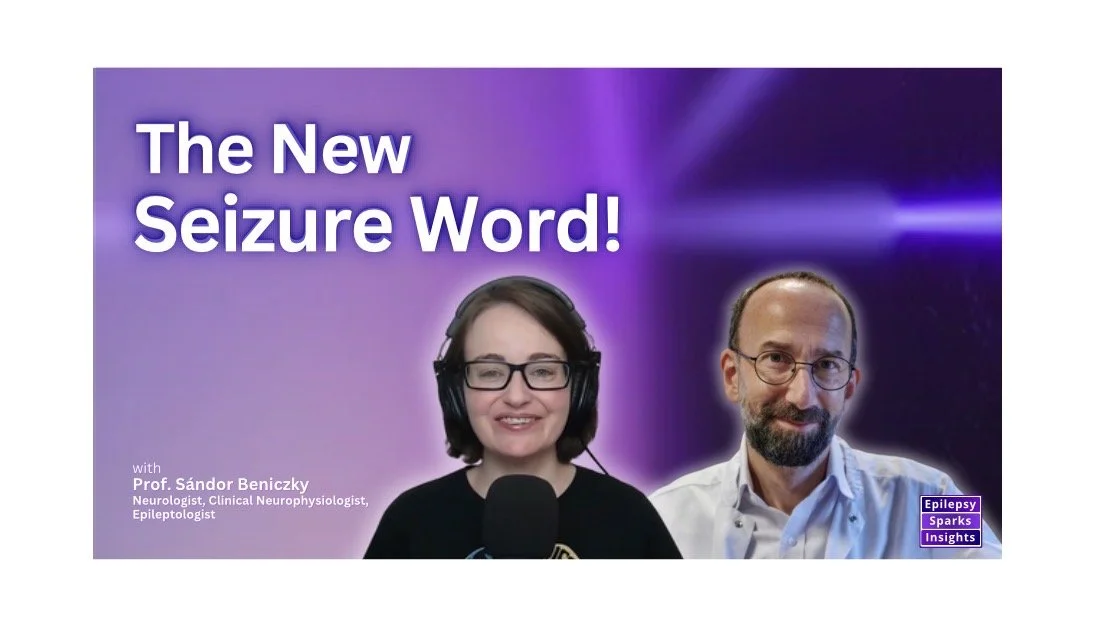
Focal Consciousness Seizures Explained - Prof. Sándor Beniczky, Danish Epilepsy Centre, Denmark
Have you heard? There's been a small but significant update re focal seizure terminology! In this episode, Prof. Sándor Beniczky breaks down why "consciousness" is now the key term used to describe focal seizures and why this change helps everyone: people with an epilepsy, caregivers, GPs/physicians, nurses, and specialists alike. It’s clearer and more intuitive!
📺 Watch the Interview
🎧 Listen to the Podcast
👉 Listen on Spotify | Apple Podcasts | YouTube
Episode Highlights
Why the ILAE has simplified seizure types and reinstated consciousness as a core classifier.
How the 2025 update improves clarity, consistency, and global usability across all levels of care.
How the new structure supports modern neurophysiology, data systems, and AI-driven tools.
About Prof. Sándor Beniczky
Sándor is a neurologist, clinical neurophysiologist, and epileptologist, and Head of Clinical Neurophysiology at the Danish Epilepsy Centre, and Clinical Professor of Neurophysiology at University of Copenhagen (Københavns Universitet). His research focuses on EEG, seizure detection, and diagnostic standards, and he serves as Editor-in-Chief of Epileptic Disorders and contributes widely to ILAE education and certification.
Full profile: sandor-beniczky
Organisations/publications mentioned:
Other things mentioned/words highlighted
seizure classification
seizure semiology
consciousness
Paper reference:
Educational paper: “Updated classification of epileptic seizures: Position paper of the International League Against Epilepsy” https://onlinelibrary.wiley.com/doi/10.1111/epi.18338 , S. Beniczky, E. Trinka, et al., Epilepsia, 23 Apr 2025, DOI: 10.1111/epi.18338
-
00:00 Sándor Beniczky
“Impairment of consciousness during the seizure means that the patient has an impaired ability to respond during the seizure and also recall the events that happened during the seizure.”
00:11 Torie Robinson
Welcome to Epilepsy Sparks Insights! I’m your host, Torie Robinson, and here we talk with specialist clinicians and researchers to spark improved understandings of the epilepsies worldwide. If you’re new here, please subscribe so you don’t miss future conversations - and let’s get into today’s episode - where we’re joined once again by the fabulous Prof. Sándor Beniczky, a leading neurologist, clinical neurophysiologist and epileptologist, whose work many of you will already know of - especially if you’ve seen our past episodes! Sándor and I are diving into his latest paper on the updated 2025 seizure classification and we’re going to talk about why these changes were needed, what’s new, and how the update will ultimately support improved communication, diagnosis and care for people affected by the epilepsies.
00:55 Sándor Beniczky
I'm a neurologist, clinical neurophysiologist, and epileptologist working in Denmark. In both my clinical work and research, my main focus has always been on quality improvement. Seizure classification is essential for managing patients with epilepsy, so, I was really pleased when the ILAE asked me to lead this initiative together with Eugen Trinka.
01:25 Torie Robinson
Tell us what problem this paper and these decisions are solving.
01:31 Sándor Beniczky
As you know, the previous version of the seizure classification has been published 8 years ago and updates and adjustments have been anticipated. So, if you read the last sentence in the 2017 classification, the last sentence is that, based on the clinical implementation of the 2017 version, updates and adjustments are expected. Now, this is exactly what we did, because please remember that the 2017 version was published before it was tried or implemented in real-world clinical practise or research. Now, we accumulated experience, we gathered a lot of feedback based on these eight years of clinical implementation. So, we did the adjustments which were anticipated.
02:26 Torie Robinson
And can you tell us exactly what were clinicians and researchers struggling with the most in the past classifications?
02:34 Sándor Beniczky
The 2017 classification is really solid. However, it got quite a bit of criticism, especially from the specialised centres. So, many epilepsy monitoring units and many specialised centres doing presurgical evaluation felt they could not implement that at the level of granularity that they need. So, the seizure classification did not include the seizure semiology or did not reflect the seizure semiology at a level which was needed at this specialised centre. So, again, the framework was robust, and we definitely kept that, and we tried to introduce more flexibility into the system so that now it can be applied in a broad range of conditions from primary care to specialised centres.
03:30 Torie Robinson
Just for people who aren't sure, what exactly is primary care?
03:33 Sándor Beniczky
That's the family physician, for example, or emergency.
03:36 Torie Robinson
So, what are the important or most significant changes?
03:40 Sándor Beniczky
I think the most important one is that we simplified it. So, in the 2017 version, we had 63 seizure types. Now, we reduced this to 21 seizure types, plus, of course, the four main seizure classes. So, it's less than half of what we had before. I think this improves also the visibility and the applicability. And then we have clear classification rules. These are called taxonomic rules. So, we clearly define what is a classifier and what is a descriptor. And very importantly, we brought back consciousness as a classifier into the system because that was also one of the important points of criticism of the 2017 version. Now, neurologists felt that they were separated from their colleagues because “consciousness” was replaced by “awareness”, which was proposed only in epileptology. So, we brought "consciousness" back into the seizure classification
04:46 Torie Robinson
We actually did some work on that together before, and we had an episode on that. To me, it makes perfect sense that we use consciousness instead of awareness because that sounds more definitive, I think. What is awareness? But then I know lots of people also might say, "What is consciousness?" So, can you just give some sort of an answer to that, please, and how they are separately defined?
05:13 Sándor Beniczky
So, again, if you approach it from a philosophical point of view, then of course, consciousness and awareness also is very difficult to grasp. However, in medicine and in neurology, we have clear operational definitions for consciousness. It's operationally defined by the ability to recall (and this is the awareness) and the ability to respond and react during a seizure. Now, both are very, very important. So, it's not that we remove the awareness or assessing the ability to recall, no, we kept that, but importantly, we added also another important feature, the responsiveness. We only introduced one seizure type, which was not in the previous classification, and we did that based on robust evidence, and that was the negative myoclonus. All others are there, we just structured them in a more simple and straightforward way, and also we resolved some internal inconsistencies. So, it's not that we made up some new things; contrary to that, I think that the terms we are using now are self-explanatory. Just let me give you an example, so, there are seizures when the consciousness is impaired, the patient is not able to respond, and those who observe the seizures, also family members or caregivers, or personnel in the hospital, they report that the patient is not able to respond, has blank stares, and the patient cannot recall what happened during the seizure. Now, in the 81 classification, this was called a complex partial seizure. If you talk to anybody who did not read the details about the classification system, what is “complex”? So it's not self-explanatory, or to a medical student, what is “complex”? Now, in 2017, this was with “impaired awareness”, but “awareness” is not a broadly used term in medicine. So, again, it needed some additional explanations. However, if a medical student who does not know much about epilepsy reads “focal seizures with impaired consciousness”; it's self-explanatory. It's really clear. So, we did not reinvent the wheel. We just tried to make things more clear.
07:51 Torie Robinson
Although this is clear to clinicians, I'm not sure it's completely clear to people with epilepsy and their caregivers. How do we overcome that, do you think? Because a lot of decisions made about epilepsy go on what the patient and the caregiver tell you.
08:09 Sándor Beniczky
We investigated this both during the updating procedure but also afterwards. Now, what we found before is that also the patients and the caregivers are well familiar with the concept of consciousness, and actually, when we went on the homepage of the Epilepsy Foundation (in the U.S.), this was very clearly explained on the homepage, even before our update was published (that impairment of consciousness during the seizure means that the patient has an impaired ability to respond during the seizure and also recall the events that happened during the seizure). So, this was out there, and I think the explanation is really simple, and, we conducted a multinational survey study asking patients and caregivers, and 98% of the respondents were able to understand this. And we also checked on some case questions: we asked whether they can apply this, and they were able to apply this. So, again, although from a philosophical point of view, consciousness may be hazy, when you apply it in clinical practise, the operational definition makes it clear.
09:24 Torie Robinson
What are going to be the real-life benefits for people with this change in terminology?
09:29 Sándor Beniczky
The biggest real-life benefit would be that this updated classification will be able to be used or implemented in this broad range of care, again from primary care to specialised centres. So, we have a common language which suits everybody, or all levels of care. I think that's the biggest benefit of it.
09:54 Torie Robinson
And do you think it will help clinicians make more informed decisions about a person's care compared to before?
09:59 Sándor Beniczky
The physicians will keep pursuing the highest quality level, and we will not change their practise. In contrary, I would argue that the updated classification system better reflects the best clinical practise. Now they really can describe or report in the classification system what they really do. So, we won't change the best clinical practise; we adapted the classification so that the classification reflects the best clinical practise.
10:34 Torie Robinson
That would go for practises globally, then, I guess as well. I assume if we can get clinicians globally to use this different language and use the new classifications, that would lead to more consistency around the world.
10:48 Sándor Beniczky
And please remember that there were also issues with difficulties of translating “awareness” into many other languages because that nuance does not exist in many languages of big global circulation, like Spanish, for example.
11:06 Torie Robinson
The new terminology is, I presume, more effectively translatable?
11:11 Sándor Beniczky
Before we published the update, we've checked whether this is translatable. So, now, almost 20 translations are already available on the homepage of the ILAE. So, we did not attempt to check translatability after we published it. We did that before.
11:30 Torie Robinson
How does the 2025 update support modern neurophysiology and where the field is going as a whole?
11:38 Sándor Beniczky
Again, because we improved the structure, there is a clear hierarchy, there is a clear structure in the updated seizure classification, it's easier and more clear how to implement this in large databases, which of course facilitates training AI models and also the technological advancements.
11:59 Torie Robinson
You said in the study and the work that was done before the implementation of this new term, it appeared that lots of people, vast majority of people, don't have a problem at all with the new terminology. But I've spoken to quite a few people, patients and clinicians alike, who have moaned to me about it, "Oh, they're changing something again, what are they going to change next? Is it worth me learning this new terminology?" With some people with epilepsy they might be more likely to say “simple partial seizures” or “complex”, or something like that. What are your thoughts on that?
12:34 Sándor Beniczky
I believe that those who know the 2017 classification will easily learn this. So, if you approach this with an open mind and then just take a little time to read the position paper of the ILAE and the practical guide, which we have just published in Epileptic Disorders, then you can easily learn it. It's very logical, it reflects what you are doing in the clinical practise. Now, of course, there is always resistance towards new things, but again, this change was anticipated - 8 years; that's comparable to the latency between updating classifications in other fields of neurology too, and it's an update. It's not a total revision. So, just take your time, approach it with an open mind, and I'm sure that all this resistance will be overcome.
13:33 Torie Robinson
I've read the paper myself, I think it's been written in a way that most people can actually understand, which would enable people to implement the changes more easily, right?
13:43 Sándor Beniczky
Yes, that was one of our major goals indeed.
13:47 Torie Robinson
Do you have any tips for fellow clinicians implementing the new terminology? Some who might struggle because they're not that open to change, as we mentioned, or because they feel, "Oh my God, it's something else I have to read when I'm overwhelmed as well." Do you have any tips for these people?
14:04 Sándor Beniczky
Try to approach this without any prejudice. And again, the terms are so self-explanatory that not just an epileptologist, basically…
14:14 Torie Robinson
Yeah.
14:14 Sándor Beniczky
…any medical personnel would understand this quite easily. And it's simplified - you don't have to learn new things or new concepts. Again, this is not a new classification, this is an update which corrected the glitches which were in the previous version - minor glitches, I must say, which were in the previous version, and this is based on evidence and based on experience in implementing that in both clinical practise and in research.
14:44 Torie Robinson
What would you say to people saying, "Okay, so they made these changes again. Are they going to make more changes to it in another 7 years?" What's your response to that?
14:53 Sándor Beniczky
This change was anticipated. So…
14:56 Torie Robinson
Yeah!
14:56 Sándor Beniczky
…the previous version has clearly stated that adjustments and updates will come. Now, new update is not anticipated. We did not include such a sentence. Why? Because there was the robust framework which has been mainly validated in the experience, and then we just corrected minor inconsistencies, so, we do not expect a new update. However, as the knowledge increases in the clinical field, we cannot exclude that when groundbreaking new knowledge will be available, then perhaps another update will be needed, but this is not anticipated, this is not expected this time. And again, when the 2017 paper was published, this was anticipated because the paper was published without any experience in applying it in the real world.
15:57 Torie Robinson
Also, there's been a really cool, very simple document produced by ILAE YES (Young Epilepsy Section), hasn't there?
16:04 Sándor Beniczky
Right.
16:05 Torie Robinson
Which. it clearly shows the changes very simply, I think, and the different seizure types. Do you think that's a cool thing?
16:13 Sándor Beniczky
I think it's very informative, and again, it highlights that this is not a new classification system. So, if you are familiar with the 2017 version, then you easily can understand and very rapidly learn the updated version. This is not a new classification; this is an updated version.
16:31 Torie Robinson
And for people who are like, "Oh, where do I find all this stuff?"- well, we will have a link to it on the website, a link to it below this recording, also, you'll be able to find the picture we just referred to from ILAE YES.
16:43 Sándor Beniczky
We've just published a practical guide. So, the position paper that's written more for the experts, and it explains the procedure in detail. Now we supplemented that with an educational paper, a practical guide to how to implement this. It's published in Epileptic Disorders, and it's an open-access paper, so anybody can open it and read it.
17:10 Torie Robinson
And so, what would be your key message with all of this? What do you want people to leave with this episode?
17:17 Sándor Beniczky
Don't think that you have to learn the seizure classification from scratch. The updated seizure classification reflects your best clinical practise. So, approach it with an open mind, and it's easy to learn and it's easy to apply it in your clinical practise.
17:34 Torie Robinson
Thank you so much to Sándor for joining us again and for guiding us through the rationale and practical value of the new seizure classification. I hope this conversation helps clinicians, carers, and people with an epilepsy to feel more confident to navigate and use the latest terminology.If you found today’s chat helpful, please give it a like and subscribe, and hit the bell so you’re notified when new episodes drop. I’d love to hear your thoughts or experiences in the comments below - I do actually read them! See you next time.
Search for an episode here
4 latest episodes
Reported by Torie Robinson
Edited and produced by Carrot Cruncher Media
A parent-led insight into life with Dravet Syndrome, this episode explores family dynamics, caregiving roles, and findings from an ethnographic study capturing the lived experiences of families across Europe.