
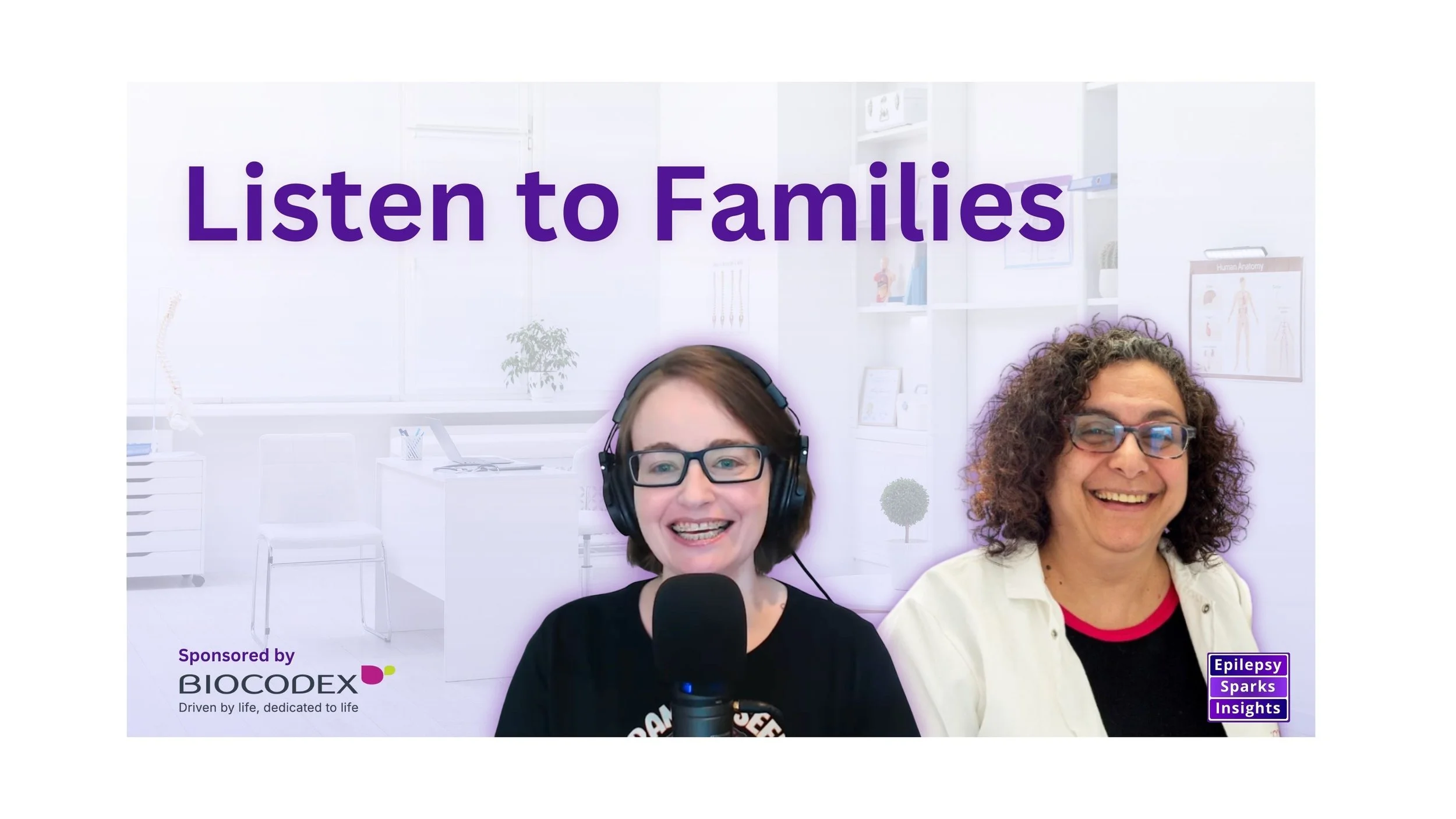
What Life Is Really Like for Families Affected by Dravet Syndrome - Rébecca Hubert, Mum & Vice President, Alliance Syndrome de Dravet, France
This episode explores the lived reality of the rare epilepsy Dravet Syndrome - through the perspective of families - drawing on insights from European ethnographic research. Rébecca Hubert, a parent and Vice Secretary of Alliance Syndrome de Dravet, shares how life with Dravet unfolds across childhood, affecting not only seizures but behaviour, routines, emotional wellbeing, family dynamics, and more. The conversation highlights why understanding family experience is essential for improving care, clinical practice, and quality of life.
📺 Watch the Interview
🎧 Listen to the Podcast
👉 Listen on Spotify | Apple Podcasts | YouTube
Sponsorship disclosure:
This episode was sponsored by Biocodex. The sponsor proposed the topic, selected the guests, and reviewed the planned questions in advance. The discussion, recording, and final editorial decisions were made independently by Epilepsy Sparks. The sponsor reviewed the edited episode prior to release and did not request changes.

Episode Highlights
A parent’s lived experience of raising a child with Dravet Syndrome
How Dravet affects daily life beyond seizures - behaviour, safety, and routines
The emotional impact of hypervigilance, guilt, and shifting caregiver roles
Why ethnographic research helps clinicians understand family quality of life
Balancing seizure control with quality of life across childhood
About Rébecca
Rébecca Hubert is a parent of a child with Dravet Syndrome and Vice Secretary of Alliance Syndrome de Dravet (the French national patient organisation). She is also a caregiver to four children (one of whom has Dravet) and an active advocate for improving how family experiences are understood in epilepsy care and research.
Full profile: Rébecca Hubert
Organisations/publications mentioned
Topics and terms mentioned
dravet syndrome
developmental delay
behavioural challenges
hypervigilance
ethnographic research
caregiver roles
patient organisations
Paper reference:
The seen and unseen facets of Dravet syndrome across the disease trajectory: Insights from European ethnographic research, https://www.epilepsybehavior.com/article/S1525-5050(25)00549-9/fulltext, Dorris L, Aras LM, Danse M, et al., Epilepsy & Behavior, Jan 2026, DOI: 10.1016/j.yebeh.2025.110809
-
00:00 Rébecca Hubert
“I was at the supermarket on Christmas Eve, shopping for dinner, and I was in the toy department when Gian had a seizure. So first I have a lot of trouble to getting him out of the shopping cart. Then I put him on the floor until the seizure stopped. And when I looked up, the area was empty! On Christmas Eve, the toy aisle was empty.”
00:28 Torie Robinson
Today we’re joined by Rébecca Hubert, a full-on mum of four(!) from near Paris, and Vice Secretary of Alliance Syndrome de Dravet. Rébecca shares her family’s journey with their youngest child, Gian, who lives with the rare epilepsy called Dravet Syndrome. She speaks with us about the daily realities and challenges that most people just never, sort-of, really see, and the small but meaningful adjustments that positively shape family life. We’re also going to hear about how this was shared via the Biocodex ethnographic study - called: “D’Unseen” - which is aiming to help clinicians really understand families’ lived experiences - so that they can provide care and treaments that better addresses their needs.
01:24 Rébecca Hubert
I'm Rébecca Hubert, I'm 35, I live near to Paris and my husband and I have a large family with four children, and our youngest, Gian, is three and a half years old and he has a Dravet Syndrome. I was tour manager but I stopped working now to take care of Gian and of the rest of family also. And I'm also the Vice Secretary of Alliance Syndrome de Dravet, which is the French national patient organisation. You know all about me now!
02:00 Torie Robinson
That's great! Could you give us an overview of what Dravet is and how it can affect the patient but how it can [also] affect family life? What is it?
02:11 Rébecca Hubert
Dravet Syndrome is a rare and severe form of epilepsy due to a genetic mutation. So, it really has disrupted our family dynamic. When the first seizure appears and during the first year, Gian was, for example, very sensitive to viruses and had seizures that required hospitalisation, almost every month. So, we completely isolated ourselves from family and from friends and even considered taking the children out of school to prevent them from bringing viruses home. But then, we realised that we cannot continue to live like this and we started to live again with a few adjustments. So, Dravet Syndrome is not just epilepsy [sic], it's also behaviour troubles and a lot of things. So, we have to make sure he sleeps well, for example. And we have all the time a thermometer and emergency medication. My son is sensitive to heat also, for example. So, we made a lot of adjustments. Itt's a cheerful baby, empathetic, and full of love!
03:40 Torie Robinson
And so, we're going to talk a bit about a study that you've been involved in. Why did you decide to become involved in a study into the lives of people affected by Dravet Syndrome? Like, what was your motivation?
03:56 Rébecca Hubert
When the association told me about that, I immediately liked the idea of providing an inside vision. During the consultation, the doctor sometimes asked “How are things at home? How is your life?” And participating in the study is like saying “Okay, come on in, we will show you what life is like for a large family with a child with Dravet Syndrome”. Even if bringing strangers into my daily life wasn't easy, after discussing it as a family, we decided to take part of the experience.
04:39 Torie Robinson
And that's what we need is, I think, for clinicians to be able to see what it's really like for a family to live with a child who has Dravet Syndrome.
04:48 Rébecca Hubert
Yeah. In a larger family… because the hardest part is that he requires constant supervision, which leaves little time for the other children. And it's one of the difficulties that I want to show and to explain. You have to adapt. You have to adapt our outings for behavioural problems - for example, to make a visit to a museum or to go to the restaurant is a little complicated. So, we have to make sure it's quick. And we have to also manage the frustration of the others when the plans have to change because of seizure or because something like that.
05:34 Torie Robinson
Or behaviour or... I've heard from lots of parents before who said that they feel a guilt because they can't give as much attention to their other children because of their child with Dravet Syndrome. Has that affected you in that way?
05:48 Rébecca Hubert
A lot because we always wanted a big family. My children are close in age. My eldest is 10, the second one is nine, and my daughter is five. So just two years old between her and my son. But I haven’t any time for her. For example, this year she has to learn to read, you know, because it's the first term that's she will… So, for homework, [it’s] difficult for me to be here 100% with her because the other one is always doing something wrong! So, I feel a little guilty sometimes, but I have no choice!
06:37 Torie Robinson
And then there are simple things like… so before we started chatting, I said, do you have a plant for your video in the background? And you said “I cannot….
06:45 Rébecca Hubert
Haha!
06:45 Torie Robinson
“... because my son might eat plants.”. I know, I think there are lots of little things like that that people don't realise!
06:53 Rébecca Hubert
He broke everything, so no, I don't buy again what he broke because he will break it again.
07:03 Torie Robinson
Nno, totally. And of course it could be… it's not just the children or your son may break things, but you know, it could, they could injure themselves as well.
07:12 Rébecca Hubert
Yeah, I have to hide everything. For example, project for laundry or the project for cleaning, or because he like, he loves eat sponges, for example. So, I have to hide the sponges! I have to be careful with the toilets because into the toilets, you know, there is balls for the perfume? He like to take it and taste it and “urgh”!
07:44 Torie Robinson
What about your son's cognitive function? How does Dravet affect his intelligence, shall we say?
07:49 Rébecca Hubert
In general, the syndrome causes developmental delays that usually become apparent after the age of 3 or 4. In most cases, children have language difficulties, poor motor coordination, intellectual disabilities, autistic disorders, behavioural disorders, sleep and eating disorders, haha, and motor difficulties also. So, it's a nice programme!
08:21 Torie Robinson
Haha!
08:20 Rébecca Hubert
Today he is he is three and a half. He's three and a half and he act like if he was maybe 18 months - so more like a baby. He tried to speak but not correctly. He walked - he walks like if he drinks a lot, so he can walk, but “Ooo”, haha! But it's so nice and he understands everything and we have a nice emotional relation. And that's the most important. And he has the same with his father, his brother, and his sister. So that's the most important for me.
09:05 Torie Robinson
So, he feels the love, and they feel the love from him as well.
09:08 Rébecca Hubert
Yeah, yeah, yeah. For example, he started mainstream school this year with a special assistant to help him. And it was a really strong struggle for me, so I'm very proud of that. But for example, when the school starts, you know the children, everybody is crying, everybody wants his mum - not mine!
09:30 Torie Robinson
Haha!
09:31 Rébecca Hubert
He say “Bye, bye, bye, mama.” and he go to every children's he will come to hug them because they are crying and he tell me “Mum! Cry, cry!”! Yeah, bye…!
09:45 Torie Robinson
It's so interesting how different people with Dravet can be. They can have, on paper, the same symptoms, but the severity of the symptoms can vary so much, correct?
09:56 Rébecca Hubert
Yeah, exactly. Some of them have relational problems. Sometimes they can speak very well. Some of them can write and try to read. So, it really depends on lot of things. Every Dravet child is different. It's a certitude.
10:19 Torie Robinson
As part of this study, we have four different types of people that were identified - people being like caregivers like yourself now they were a PA a Maestro or Conductor a Gatekeeper or a Castaway. Which one do you say that you are or how many of these roles have you been in have you had?
10:44 Rébecca Hubert
I think every parent has played of this role at some point. But let's just say that with a child with a disability, it's more intense, in fact. Also, it depends where you are in the journey of the Dravet life. For example, at the diagnostic, I think a lot of them are “cast away”, alone in the sea… I'm lost at the sea and I'm calling for help - that's true, the first seizure for example! But obviously, I'm his Personal Assistant, you know! I know his needs, I make sure he takes his medication, I check his temperature every time, I take him to his education session... He has more social life than me, in fact! But I'm also a Maestro and a Fighter because I organise his schedule, his appointments. I have to remember to order and pick up his medication. And sometimes I forget. And that's when I realised the limits of the role of Conductor or Maestro. And yes, so about the Castaway, that's how I felt during the first crisis and today it could still happen, and when it does, I know now I can turn to the families I've met in the association Alliance Syndrome de Dravet because they are like a lifeline. They have the same life as me and they understand. Even they don't know me as Rébecca, they know me as a parent of a Dravet children. So, we can have lots of exchanges like. And sometimes I'm a Gatekeeper because I need to understand in order to move forward. I need to understand why and okay after it's okay and I can move.
12:47 Torie Robinson
So, it's not just that your roles change from, say, diagnosis to… and then two years later and then two years later, it's like your role can change within a day or two as well, how you feel and what you do.
13:01 Rébecca Hubert
Exactly. For example, when there is a difficult night with a storm of seizure, maybe three, four seizures on the night, and I cannot sleep, I have to take care of him all the night, maybe to go to the hospital. Maybe in the morning I will be Cast away, that's sure. But my husband will take his role for the day, and I can have more time for me.
13:34 Torie Robinson
An example, I think, of how Dravet can affect your life is how we had to reschedule our recording, didn't we…
13:39 Rébecca Hubert
Yeah, haha.
13:40 Torie Robinson
…for this podcast, because of things about your son. And it was a last-minute thing, there was no choice in it, we had to just reschedule. It really made me think of how that must happen again and again and again in your life.
13:55 Rébecca Hubert
Yeah, and for example, when we have the first chat, when I met you for the first time, just a few minutes before my son had the seizure. So, I have to say “Two minutes, I have to control the seizure!”, and I come back and I replace my mask of a “normal” person! But two minutes ago, I was the mom who had to take care to be cool. So that's our life.
14:24 Torie Robinson
So, how was your charity involved in this study?
14:28 Rébecca Hubert
The charity name is Alliance Syndromes de Dravet, which is the French patient organisation. And they participate to provide a better understanding of the French ecosystem, with two ways: firstly, involvement of association board members with interview about involvement and mission within the association. And also, they recruit families to attend meetings. We select the profiles according to criteria of age and family composition to be as representative as possible. And also, they present the project to the families before the ethnologist contacts them.
15:15 Torie Robinson
15:17 Rébecca Hubert
Five families: three from France, one from Italy, and one from Spain.
15:23 Torie Robinson
And how old were the patients with the Dravet Syndrome?
15:28 Rébecca Hubert
So, my son, Gian, was two and a half years old at the time of the study. One was four and a half, nine and a half, and 10 years old. So, most of young patients.
15:44 Torie Robinson
How severe were their symptoms across the families? Because I know in Dravet, some people will have “these” symptoms and others won't, and sometimes they'll be really severe and sometimes they won't. Was there a variation in that amongst the patients?
15:58 Rébecca Hubert
For most of them: talking difficulties, intellectual disability, some of them attending mainstream school with special assistance, or will go to special school. And I don't know them personally, so I just read the results of the study, but the disorder that I tell you are the most that they have in common.
16: 27 Torie Robinson
And, so, what were the objectives of this study? What was supposed to… what did you want to happen as a result of the study?
16:36 Rébecca Hubert
To have a publication that informs professionals about family's experiences. Written by an ethnologist, someone who is neutral and has an objective perspective without biases and based on families' experiences and needs. And after, then work together to find solutions for improvement and a common basis - is a real, real important work and new way to do.
17:08 Torie Robinson
I guess, if clinicians can better understand what life is like for - not solely the patient with the Dravet Syndrome but the whole family - then they can improve the quality of life of the patient and the family simultaneously. Is that right?
17:24 Rébecca Hubert
I hope that this will enable professionals to adapt their practices to the emotional state of families and to have a more comprehensive view of Dravet patients, and the view of their family and the quality of life of the patient, but also the families - because it's a big part. There is no Dravet patient alone. So, the Dravet patient is with his families.
19:59 Torie Robinson
So how did you work with the ethnologist? What was the experience like for you and your family? Was it informal or formal? Was it awkward? What was it like?
18:14 Rébecca Hubert (24:48.991)
Oh, it was really friendly, In fact. !we immediately have a nice feeling! And the meeting was like having cousins for a visit! We shared toast and coffee in the morning and they went with me to the psychomotor therapist station, and they have an interview with her to tell about her practice. After we picked up the older kids at school for lunch and we shared lasagna (they don't criticise my lasagna so it was a nice experience!). They played basketball with the older kids and it was really cool and natural like “Follow me and live my life.”. But I think it was intense also for them, because she asked me “It's like this every day?”. And I said “Yes, but today there is no seizure. So, it's a calm day!”.
19:19 Torie Robinson
Did they seem surprised or…. about what your experience was like?
19:25 Rébecca Hubert
I was surprised because it was so easy, in fact, and real. The feeling was okay directly and…I have no other word that it was like real life and a sincere experience.
19:47 Torie Robinson
Some families are really unfortunately ashamed of certain symptoms of Dravet Syndrome and developmental epileptic encephalopathies in general. So, has this study revealed some of these things in a useful way?
20:04 Rébecca Hubert
For my part, I'm not ashamed of the symptoms, but I do feel more sometimes lonely, you know? My son is young, and so when he had a seizure in public, people often don't notice it or deliberately ignore it, in fact. I have for you an anecdote: I was at the supermarket on Christmas Eve, shopping for dinner, and I was in the toy department when Gian had a seizure. So, first I have a lot of trouble to getting him out of the shopping cart. Then I put him on the floor until the seizure stopped. And when I looked up, the area was empty! On Christmas Eve, the toy aisle was empty! So, I take a picture. I can send it to you because it's a “fun” fact, I think, about epilepsy. But... however, the study reveals that Dravet is not just epilepsy [sic] and as a mother, one of the most difficult things to deal with are the behavioural problems. The frustration, for example, when he pulls my hair or when he screams, he screams in a restaurant because it's too noisy for him. Or when he have to… I have to fight with him to get him into the seat car (if you see me do that you can think I'm an awful mum but I have to put him to put him in the car seat - no choice!). So, in this case, I can be ashamed. And I think the emotional odyssey of the study revealed that we have this up and down journey from the first stage to the adulthood because living with someone who has epilepsy - you know that better than me(!) - means being hypervigilant all the time and it's like to live with a big cloud over the head. It can rain at any moment. And, for example, as a parent if we go to a party (it's not often!), we have to stay sober! You cannot drink because (or at least one of us have to!), because we have to be always in control!
22:43 Torie Robinson
When you have such good wine!
And being hypervigilant all the time is exhausting, I think, mentally and physically, actually, because you are always on edge. Imagine: it's almost like being in an interview 24-7, you know? Only the difference is it's somebody you love that you are looking after.
23:04 Rébecca Hubert
I'm also the secretary of the association, so, every year I have about 100 emails or call or phone call from families who have the diagnostic or who have in in a moment of the emotional odyssey. Why is it difficult and they need us? So, the first thing I can tell to this family is to have tools for example to control the seizure. For example, I have a bracelet for my son that I put on his wrist and it sends to my phone all the information about temperature, the rhythm of his heart, and if there is a seizure the rhythm grow up and it's ringing, and I can just watch TV a few minutes without the hypervigilance. So, it seems sometimes “gadget” but for us it's just the way to have a normal life during a few hours per day.
21:19 Torie Robinson
A normal life, whatever that is, right? Or as normal as your life can be, I suppose.
24:23 Rébecca Hubert
Yeah, that's exactly.
24:26 Torie Robinson
So this study, and the paper that resulted, has it shown an improved understanding of what it is to be a family affected by Dravet Syndrome?
24:35 Rébecca Hubert
The biggest surprise for family is that despite differences in culture, care and social background, we all go through the same emotional odyssey. It's proof that the study was sincere.
24:56 Torie Robinson
And did it show that the anthropologists and the rest of the team actually understood your life?
25:04 Rébecca Hubert
I think they understood but they don't assist to a seizure. And that's what I explain to school for example I tell them I can explain you in different languages what is a seizure, I can put poster on the wall what you have to do during a seizure, even if you don't assist to a seizure you cannot know your feeling, your reaction. And it's maybe the limit of this study is to feel: what is a seizure (for a parent).
25:47 Torie Robinson
I know what you mean. You know what, when I had… I mean, I empathise with what you're saying. for instance, I'd had lots of seizures in my life, but I'd never seen a tonic-clonic before. And then when I went for video telemetry in the hospital (and it’s, the only time you want a seizure!), and I had a focal to bilateral tonic-clonic, and I asked to see the video.
26:15 Rébecca Hubert
Yeah.
25:15 Torie Robinson
And the nurse looked at me like I was really strange! Like “Why do you want to see this?!” And I said, because I want to know what other people go through”. And then a few years later my friend had the same sort of seizure in front of me and it is a very different experience if somebody else goes through it and you are there the person who needs to help look after and protect them and seek help so I totally know what you mean. It's very different
26:42 Rébecca Hubert
Yeah, yeah, so the 3D for me, is the perfect way, but the feelings, that's all maybe the limits.
26:52 Torie Robinson
So, what do you hope the outcome of the paper will be?
26:55 Rébecca Hubert
I hope t will enable professionals to adapt their practice to the emotional odyssey of the family. For example, at the diagnostic, we are the Castaway and we need time to register all the information but you need also to know because we are the Getaway we have to understand! So, it's a really precious tool for their practice, I think. And also in our associative life, it's a way to show to the family that you're not alone. We live the same and it will be better, maybe, and maybe we will be in bad mood after, but it's our journey. So, I think it's a really precious tool.
27:53 Torie Robinson
Do you think that this will, the paper and the learnings from this study, will be useful for experienced clinicians as well as new ones? Because I wonder sometimes clinicians with experience of Dravet might think they know everything already.
28:10 Rébecca Hubert
I think it's good if this vision is shared by industry, to the professionals. Because it's not the parents and the family who say, it's difficult for me this time. We all say the same. So, it's really a precious tool. And I think this project has created a solid basis for exchanges, ideas and adapting practices to developing projects around this kind of study. And the most important for me is it gives more weight to what families have to say, and the conclusions of the study are in line with the feelings of the association in the extent that we have with family. And we have the same result in France, in Italy, in Spain. So, it's an international vision, finally.
29:19 Torie Robinson
That's really, really cool. And I was wondering about this, personally, thinking, I know from patient experience and speaking to other patients and families; sometimes when they go to appointments with a clinician, they think all I have time to talk about is seizures. This is all that seems important. But I hope - and I wonder if you think this as well - that this paper can contribute to patients feeling more confident to speak about other symptoms or the environment and also for clinicians to ask about these other things. What do you think?
29:57 Rébecca Hubert
For me, the most important is the balance between control of seizure and quality of life. If my son [is] having seizure every day, cannot go to school and it will be complicated. So, I will maybe think about other therapeutics to adjust that. But if it's okay for me, one seizure per week is okay for me because I don't want to give him more therapeutics and have at home a child who is not my child finally. So, it's really a balance. And the difficulty, for example, at the adolescent or at the adulthood when there is a changement in the body, it's to adapt the therapeutics to keep this quality of life.
30:57 Torie Robinson
Also social and community support as well. So again, not just the seizures… so you're saying you're looking over time at how things might change, but also look at the symptoms other than seizures and see how it impacts family as well as the patient.
31:13 Rébecca Hubert
Exactly.
31:15 Torie Robinson
You need to be able to look after yourself as well. And that's really important. I think lots of parents might feel that that's bad to say that it should always be just about their child, but it's so important to have quality of life of parents and siblings as well. So I'm really grateful that you've communicated this, and also, well, just so glad about this study and personally and professionally, I really hope that we can get this out to more families and clinicians to improve the lives of other people affected by Dravet and other DEEs around the world. Thank you.
31:54 Rébecca Hubert
Thank you to invite me and to give weight to families, I have to say. I think it's my job as a mum to speak about the Dravet Syndrome and also for other family to give them hope when they are the Castaway. Give them hope that it will be better. It's my job as a parent. But if I can give a little bit hope to other family and tell them you're not alone and together we go further.
32:27 Torie Robinson
Thank you so much, Rébecca, for giving us such an honest, powerful insight into your family’s life with Dravet Syndrome, and for showing how essential it is for clinicians to understand the emotional and practical realities behind the epilepsy. Rébecca’s contribution to the D’Unseen ethnographic study, and her work with Alliance Syndrome de Dravet, is helping to reshape how professionals support individuals and families. And thank you all for watching!
If you found our conversation helpful, please give it a like and subscribe, and hit the bell so you’re notified when new episodes drop. I’d also love to hear your thoughts or experiences in the comments below - as you know - I do read them! See you next time.
Search for an episode here
4 latest episodes
Reported by Torie Robinson
Edited and produced by Carrot Cruncher Media
A parent-led insight into life with Dravet Syndrome, this episode explores family dynamics, caregiving roles, and findings from an ethnographic study capturing the lived experiences of families across Europe.